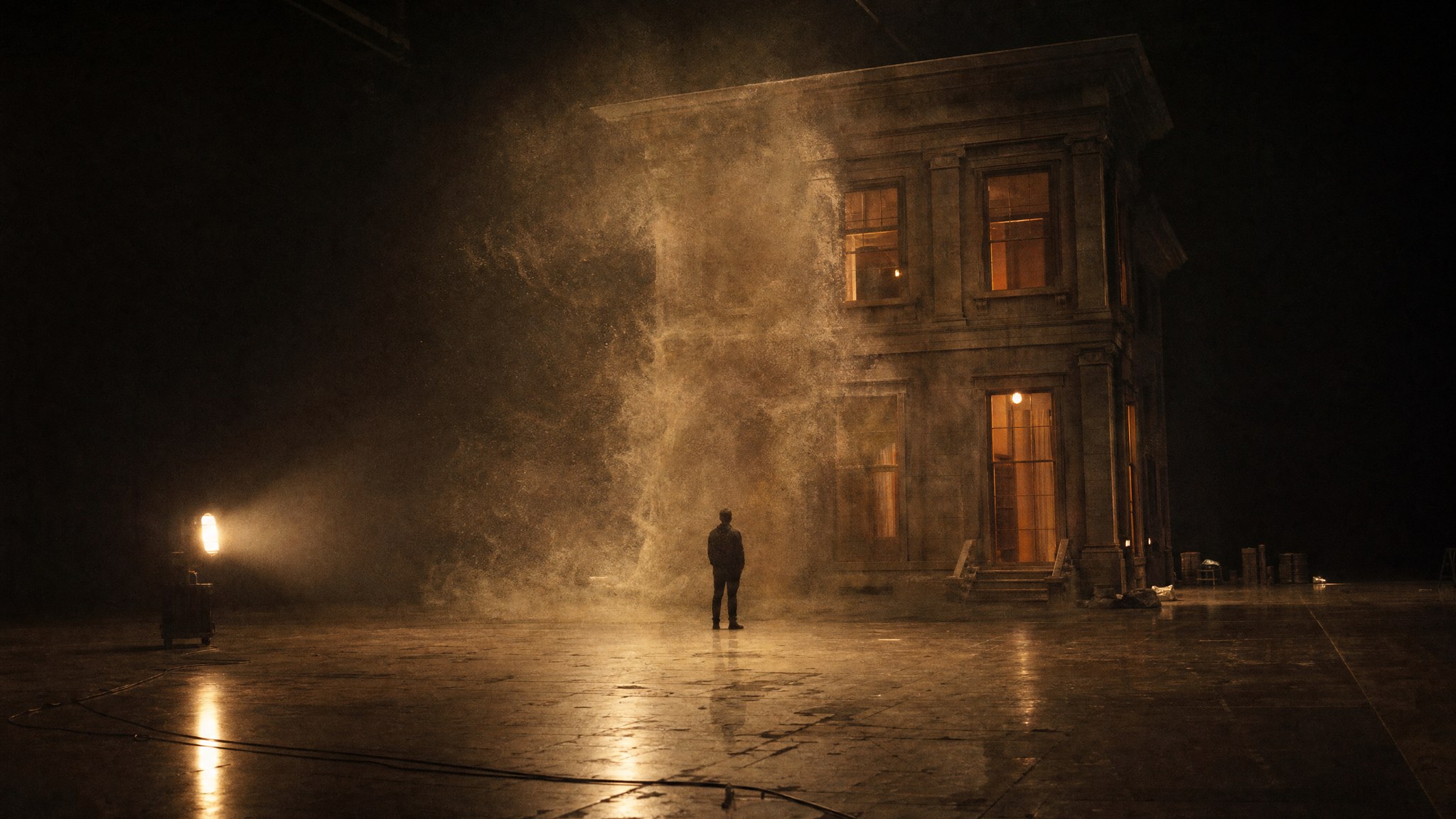
Every project that does not exist yet has the same problem. The person who has to say yes cannot see it. They can read it, they can be told about it, they can look at reference images pulled from other people's films. What they cannot do is watch it. So they do the rational thing and they hesitate, because saying yes to something you cannot see is not caution, it is guesswork.
A cinematic proof of concept film is the answer to that specific problem. It is a short film, made before the project is financed or built, whose only job is to let someone see the thing well enough to decide about it.
The working definition
A proof of concept film is a short, finished piece of cinema that demonstrates the world, the tone and the central idea of a project that has not been made. It is not a summary of the project. It is a sample of it, at full quality, at small scale.
The distinction matters more than it sounds. A summary describes. A sample proves. If your film is a summary, the viewer still has to imagine the finished thing, which means you have moved their problem around instead of solving it.
A deck says imagine. A film removes the need to.
What it is not
- It is not a trailer. A trailer advertises a film that exists and assumes the audience already wants in.
- It is not a mood reel. A mood reel is other people's footage arranged to suggest a feeling. It proves taste, not capability, and it proves nothing about your specific world.
- It is not a sizzle. A sizzle is a fast, energetic assembly built for momentum in a room. It has a job, but the job is heat, not proof.
- It is not a teaser for social. That is marketing for something already greenlit.
- It is not the first scene of the film. It can be, but only if that scene happens to carry the burden of proof, and usually it does not.
The question that decides whether it works
Before anything is written or shot, one question has to be answered in a single sentence: what does this film need someone to believe?
Not what does it need to show. What does it need someone to believe. Those are different films. A science fiction project might need someone to believe that a world built on one strange rule holds together visually without looking cheap. A period project might need someone to believe that the era is achievable on the budget being discussed. A character piece might need someone to believe that this particular actor, or this particular register of performance, carries an audience for ninety minutes.
Each of those is a different film. Same project, same script, three completely different proofs. Getting this wrong is the most common and most expensive mistake in the category, because the result looks good and does nothing.
The second question, which almost nobody asks
There is a companion question, and it is the one that separates a film that impresses from a film that unlocks a decision: what is the risk in this project that makes people hesitate?
Every unmade project carries a specific fear. The genre is unproven. The tone is hard to describe and easy to get wrong. The scale looks unaffordable. The premise sounds ridiculous out loud and only works when you see it. The director has never shot at this size. A proof of concept that does not aim directly at that fear is decoration.
Aim at the fear. Prove the hardest thing, not the prettiest thing.
When it earns its budget
A proof of concept is worth making when three conditions are true at once. There is a decision that needs to be made. There is a date by which it needs to be made. And the thing blocking the decision is something a film can actually resolve.
That last condition is a real filter. A film can resolve doubt about tone, world, scale, register and voice. A film cannot resolve doubt about your business plan, your chain of title, or whether the market wants this. If the blocker is legal or commercial, a beautiful film will not move it, and you will have spent budget proving something nobody was asking about.
What honest looks like
A proof of concept film improves access and consideration. It gets the project watched instead of skimmed, and it lets a conversation start from what the thing is rather than from what it might be. That is a real and measurable advantage.
What it does not do is guarantee an outcome. Most projects that get made were pitched many times before they were made, and most scripts that sell are never produced at all. Anyone who tells you a film will get you financed is selling you something other than a film. The honest promise is narrower and more useful: you will stop having to ask people to imagine.
The full breakdown of how we build these, stage by stage, lives on our proof of concept page.
A proof of concept film is a sample of the unmade project, not a summary of it, and its quality is measured by one thing: whether it aims at the specific belief and the specific fear standing between the project and a yes.
If there is a decision on your project with a date attached, that is the conversation worth having.
Start a conversation