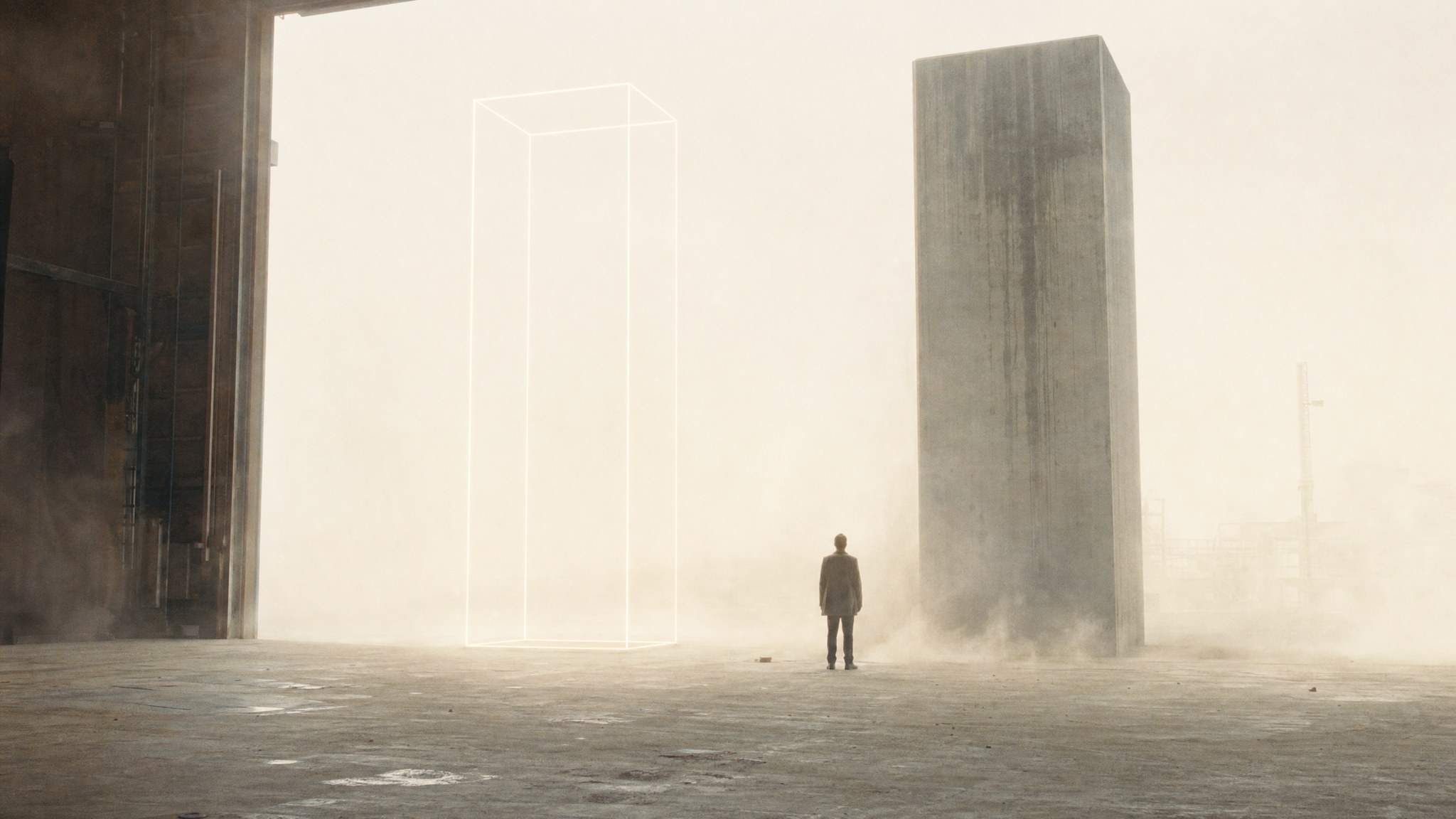
Both arrive as an MP4 of a building that has not been built. That is where the similarity ends, and confusing them is why so many development budgets produce something nobody watches twice.
What an architectural animation is
A camera path through a three dimensional model. It is generated from the same data as the renders, usually by the same team, and it is fundamentally a spatial explanation. It shows massing, circulation, relationship to site, how the parts connect.
It is excellent at what it does. For planning committees, for internal alignment, for showing a client how a scheme resolves, for a technical audience that needs to understand the building as an object, an animation is the correct and efficient answer.
How you recognise one
- The camera does things no camera does. It floats through walls, rises without support, moves at a constant speed forever.
- The building is empty, or populated by people who walk in loops and never look at anything.
- The light is perfect and unchanging, one time of day, no weather.
- It has music but no sound. Nothing in the space makes noise.
- It ends on a hero view with the project name.
None of these are faults. They are the honest signature of a technical document, and a technical document is what it is.
What a pre-construction film is
A film. It has a point of view, a sequence with a shape, characters or at least presence, sound design, and a camera that behaves as if it were physically there, with weight and with a reason for every move.
It is not about the building as an object. It is about being in it. The building is the location, not the subject, which is a much harder discipline and a completely different output.
The distinction in one test
Take the soundtrack off. An architectural animation without music becomes silent and slightly eerie, because nothing in it was ever making a sound. A film without music still has a world: footsteps, a door, air, distance, a voice in another room.
That test tells you what you actually commissioned.
When to choose which
Choose animation when the audience needs to understand the building. Planning, approvals, technical review, internal coordination, a scheme that has to be legible as a system.
Choose film when the audience needs to want the building, or to believe in it. Capital raise, launch, hospitality positioning, high value sales, brand for a masterplan that will take years and needs an identity people can hold on to before there is anything on site.
The place where budgets get wasted
Asking a visualisation studio to make the second thing. Not because they lack skill, but because the pipeline is built for a different output. The model is optimised for accuracy, not for performance. The lighting is set up for legibility, not for a moment. There is no script, no shot list built from dramatic intent, no sound design discipline, and often no director in the sense that word means in film.
What comes back is an animation with a more emotional piece of music on it, and everyone can feel that something is missing without being able to name it. The thing missing is that nobody decided what the film was about.
They work well together
This is not an argument for replacing visualisation. The strongest package we have seen is an accurate animation for the technical audience, produced by people who do that superbly, and a separate film for the audience that is deciding with something other than their analytical mind.
Different tools, different jobs, and it is much cheaper to buy both correctly than to buy one and ask it to be the other.
What we bring to the second one is described on the unbuilt projects page.
An architectural animation explains a building to people who need to understand it. A pre-construction film puts people inside a place so they want it or believe in it. Take the music off and you will know instantly which one you commissioned.
Bring us the scheme and the audience. We will tell you honestly which of the two you need.
Ask us